
Alexandria's Library....
Was not an invention of Alexander the Great!

Were there public libraries in the Middle Ages? Or even in Roman times?
When we imagine public libraries, we often think of them as a modern invention: quiet rooms, open shelves, free access for everyone. But the idea of collecting books and making them available to a community is older than we might expect. Long before medieval monasteries and Renaissance universities, the ancient world had already experimented with different forms of shared knowledge.
Public libraries in the Roman world
In Rome, the notion of a “public” library emerged surprisingly early. The first known example dates back to 39 BCE, when Asinius Pollio opened a library with separate sections for Greek and Latin texts—an architectural and cultural statement about Rome’s dual intellectual heritage. Over time, emperors such as Augustus, Agrippa, and Trajan expanded this model. Libraries became part of urban life, often housed in monumental complexes alongside baths, temples, and forums, and by late antiquity the city may have hosted several dozen libraries.
Access was generally free, but not universal. Literacy, education, and social standing acted as filters. These spaces were “public” in the Roman sense: open, visible, and prestigious, yet primarily used by the educated elite.
Alexandria and the dream of total knowledge
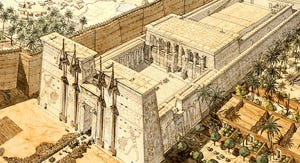
Rome, however, did not invent the library. The most ambitious experiment in the history of libraries began earlier on the southern shore of the Mediterranean. After founding Alexandria in 332 BCE, Alexander the Great imagined the city as a meeting point between cultures. His successors, the Ptolemies, turned that vision into a laboratory of knowledge.
Guided by Demetrius of Phalerum (an intellectual shaped by Aristotle’s school) Ptolemy I conceived a radical idea: to collect, organize, and preserve every book worth knowing. His son, Ptolemy II, turned that idea into reality. The Library of Alexandria was not a standalone building but part of the Mouseion, a research complex with quarters for scholars, lecture spaces, gardens, and areas devoted to scientific observation. It functioned less like a warehouse of books and more like an ancient research institute.
How the Library of Alexandria worked
Books arrived from everywhere. Ships docking in the harbour were required to surrender any written texts on board; these were copied, catalogued, and often the originals stayed in Alexandria, while the owners received reproductions. Organization mattered just as much as acquisition. Callimachus of Cyrene developed the Pinakes, an early cataloguing system that arranged works by subject and author, laying the groundwork for how libraries would think about order for centuries.
Estimates suggest that the main library may have contained hundreds of thousands of scrolls, with a “daughter library” in the Serapeum holding tens of thousands more. More importantly, Alexandria was alive: mathematicians, astronomers, poets, and philosophers debated, taught, corrected texts, and produced new ideas. Euclid, Eratosthenes, Archimedes, and many others passed through its intellectual ecosystem.
The Library of Alexandria was not “public” in the modern democratic sense. It was a royal institution designed for scholars rather than citizens at large. Yet, it introduced something entirely new: the idea that knowledge could be systematically gathered, preserved, classified, and expanded by a dedicated community: a blueprint that later civilizations would adapt in their own ways.
Roman libraries: structure, staff, and preservation
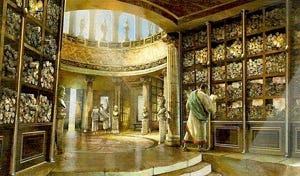
Roman libraries were more pragmatic than Alexandria’s grand experiment, but no less important. They were typically divided into two adjacent sections, one for Greek texts and one for Latin works. Scrolls were stored in cupboards set into wall niches, while statues and decorative elements reinforced the cultural prestige of the space.
Staff played a central role. The bibliothecarius, often an imperial freedman, oversaw scribes, restorers, and attendants whose work focused on access, preservation, and copying—essential tasks in a world without printing. Ancient libraries were also places of constant maintenance. Papyrus and parchment were vulnerable to humidity, insects, and rodents, so architecture, scented woods and resins, and even cats were used to protect collections. Damage was inevitable, and preservation often meant continuous recopying rather than true permanence.
Roman public libraries also developed catalogues organized by room and by author, helping readers locate texts. Consultation generally took place during daylight hours and could be free, though effectively reserved for the literate classes. Their collections were not vast by modern standards: even the library in Trajan’s Forum probably held only tens of thousands of scrolls.
After Rome: libraries in the Middle Ages
With the collapse of the Western Roman Empire, the centre of gravity shifted. In medieval Europe, libraries survived mainly within monasteries and cathedrals. Large abbeys held rich collections of manuscripts used by religious communities and scholars, while scriptoria patiently copied texts by hand. Access remained limited, often restricted to monks, clergy, and a narrow scholarly elite.
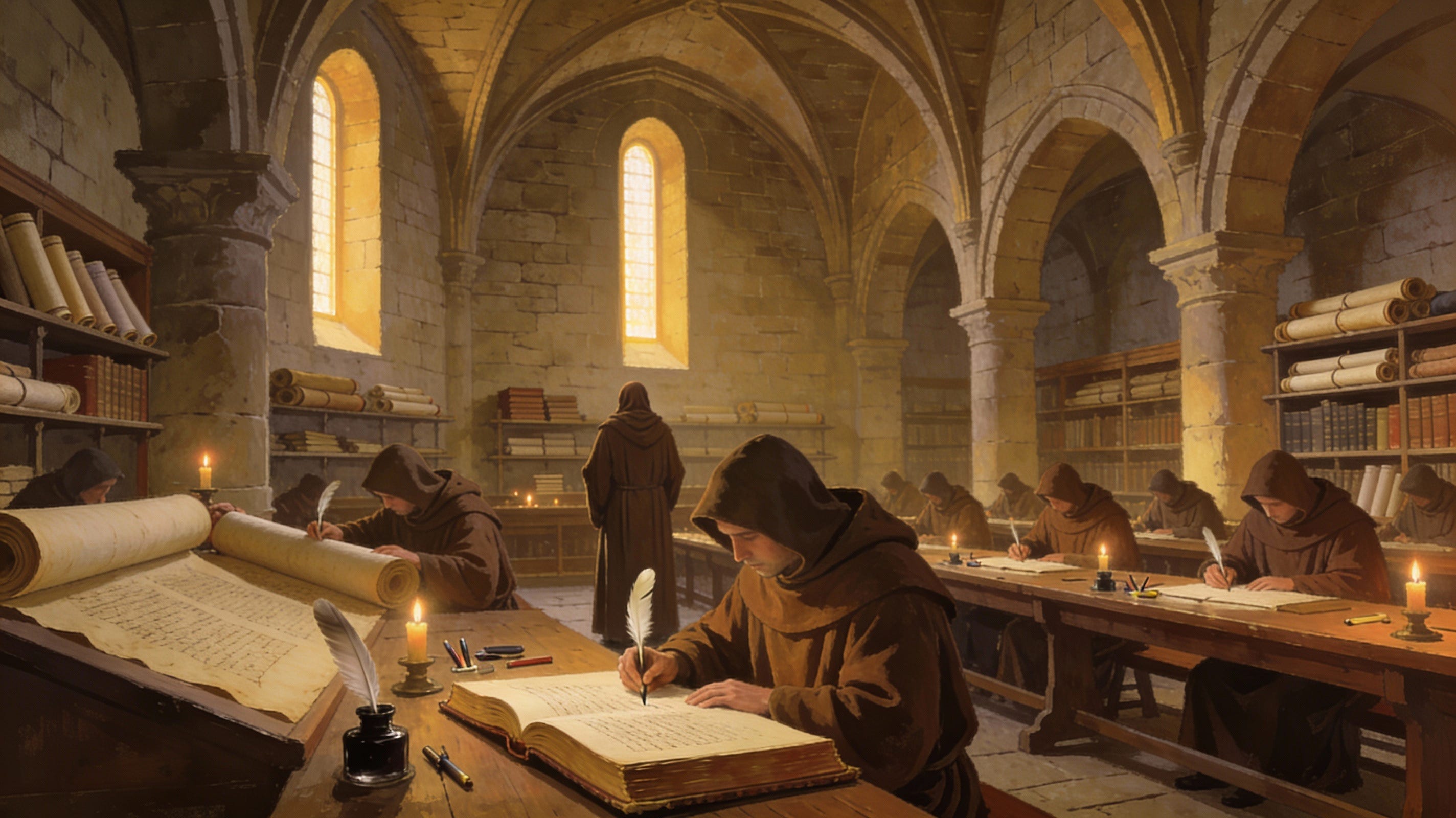
Only later, with the rise of universities and urban life, did more open collections begin to appear. The truly modern public library—free, widespread, and aimed at the general population—would emerge much later, alongside printing, mass literacy, and new ideas about education and citizenship.
Conclusion: a long tradition of shared knowledge
Seen from a distance, the story of libraries is less about buildings and more about ambition. The Ptolemies pioneered the idea of a library as a centre for preserving and expanding knowledge among a community of scholars. The Romans translated this into a network of public libraries embedded in civic life, though still limited to the educated. In the Middle Ages, monasteries took over the role of preserving and transmitting texts, until the Renaissance and the invention of printing transformed access to books and laid the foundations for the modern public library.